


London Dartboard
London Dartboard / LondonTrebles Dartboard / Standard Dartboard
London Dartboard / London Trebles / Standard Dartboard

The London dartboard is the standard Dartboard most players use and the one we all see on TV. The London dartboard has the traditional number system we are used to, a doubles ring, a trebles ring, a bullseye, and an outer bullseye. Most people refer to this Dartboard as a traditional or standard dartboard and are unaware that it has another name. However, there have been many different dartboards before the London dartboard saw the light of day. In fact, the board was not available before the 1920's, so it is only just over 100 years old.
The Yorkshire dartboard was one of the most commonly used dartboards before the London (Trebles) Dartboard was introduced. The introduction of the treble ring made the game more difficult and easier in equal measure. The treble scoring segment meant players could reduce their score quicker and check out higher numbers, so some may argue it was easier! Not in the slightest! If you are unable to hit the treble ring with reasonable consistency, you are unlikely to win a game on this Dartboard. It is now, however, by far the most popular Dartboard available. Players, new to the sport, may not realise that many variations preceded the Dartboard many of us use today and were known as regional dartboards.

The London Dartboard is sometimes also referred to as the Trebles dartboard! However, in the past, it has also been referred to by other names, including the Clock Dartboard.
The Various Dart Games and How to Play Them by A. Wellington (c. 1937-38), The Guinness Book of Darts by Derek Brown (c. 1981) and the Unicorn Book of Darts (c. 1950) refer to the London Dartboard as a Clock Dartboard. The reason why the London Dartboard is referred to as a clock dartboard is unclear, and it is now believed that the London Clock Dartboards are a reference to the London 5s Dartboards, as they have 12 scoring segments, as opposed to 20 on the London Trebles, which makes logical sense.
I believe the London Clock Dartboard reference is a misunderstanding between two dartboards used and played upon in London for many years. Some authors refer to the clock dartboard as the standard Dartboard, and this has been copied by many as the true reference. However, London Fives, also known as the Narrow Fives, is probably the correct reference as it has twelve scoring areas, like a clock. The Ipswich Fives, also known as Wide Fives, are similar to the London 5's, except the doubles and trebles are standard size, while the London 5's have narrow scoring areas for the doubles and trebles. Like much of the history of darts, as written in books or by others on their blog sites, not everything presented is accurate. Usually, a misunderstanding, or the research hasn't been thoroughly conducted. Dr Patrick Chaplin (Darts Historian) and renowned Darts Player Bobby George also share the same theory, that the reference to the London Clock Dartboard should be the 5's Dartboard, not the standard London Trebles Dartboard.
The London Dartboard has been made in various forms, including wood, paper coil, soft-tip plastic, and, of course, sisal, a material used in rope-making and derived from the sisal plant. Dartboards have also been made from clay! No, not fired hard clay, but soft clay like plasticine. However, the steel-tip dart player's Dartboard of choice is the sisal dartboard.
Dartboards have also been made in various colours and colour-ways. However, competition dartboards now have a standard colour scheme consisting of black, red, green and natural sisal or white.
Below are just a few of the others. Special-themed dartboards in the colours of football teams can also be purchased from some suppliers.

The first sisal dartboard was made by NODOR Dartboard company in 1932.
(NODOR) In 1919, Ted Leggatt, an industrial chemist, went into business, manufacturing ‘NODOR’ modelling clay. He called the clay Nodor because the clay had no odour!
Read more about the history of dartboards..
Ted also marketed the sisal dartboard not as sisal but as a bristle dartboard, which led to a lot of confusion about what the ‘bristle’ actually was! Some even said it was pig bristle or horse hair. Sisal is a plant! So I hope this clears up the urban myth, bristle dartboard is a sisal dartboard! I suppose you could argue that bristle is easier to market than sisal.
Until recent years, sisal dartboards have been constructed similarly. The sisal is first pressed and wrapped with either paper or plastic. This is then cut into discs known as a ‘biscuit’.
Approximately 20 of the sisal biscuits are then placed in a mould and compressed further to form the playing surface of the dartboard. Before the compressed sisal is removed from the mould, a backboard is glued to one side of the sisal, and a metal ring is screwed around the perimeter of the dartboard. Before painting the dartboard, the sisal is sanded to smooth the playing surface.
The veins seen on some dartboards are where the sisal biscuits meet; the compression creates a unique pattern on each board.
At the top end of the market is a triple-core dartboard. These boards consist of a multi-compressed sisal rear with a single sisal non-biscuit type top! These boards have a softer (less compressed) playing surface, which allows the dart to penetrate deeper, and the rear of the dartboard is denser than the top, which holds the dart firmly. Overall, this means darts are less prone to falling out of the dartboard. Regularly, players will note that the veins on some sisal dartboards can become exposed, and a dart can fall from the board if it hits a vein, or fall from this area if it does not penetrate deeply enough.
Top-end dartboards also have a blade, a thin metal strip known as the ‘spider’ segment divider. The metal blade segment divider is thinner than the traditional wires used to divide the scoring areas. The blade also requires no staples or pins to keep the wire/blade in place, meaning there are fewer dart bounce-outs. All top TV dart tournaments use dartboards of this construction.
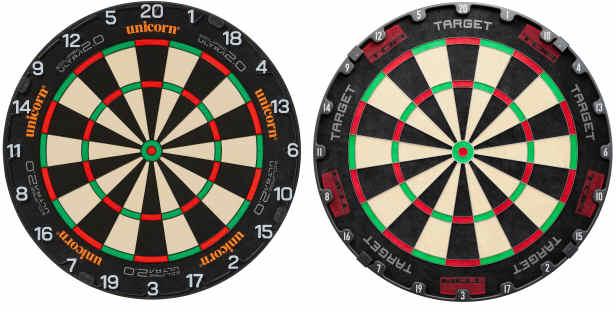
Illustrated below are two of the boards currently used (2026) by the World Darts Federation (WDF) Target TOR at the 2025 World Championships. Unicorn had a long relationship with the PDC, but is no longer their official dartboard.

What are the dimensions of a Standard / London Trebles Dartboard?
Official Dartboard Dimensions as per the former BDO |
|
| 'Double' and 'Treble' rings inside width | = 8.0 mm +/- 0.2 mm |
| 'Bull' inside diameter | = 12.7 mm +/- 0.2 mm |
| '25' ring inside diameter | = 32.0 mm +/- 0.2 mm |
| Outside edge of ‘Double’ wire to Centre Bull | = 170.0 mm +/- 0.2 mm |
| Outside edge of ‘Treble’ wire to Centre Bull | = 107.0 mm +/- 0.2 mm |
| Outside edge of ‘Double’ wire to outside edge | = 340.0 mm +/- 0.5 mm |
| Overall dartboard diameter | = 451.0 mm +/- 3.0 mm |
London Trebles Dartboard Set-up:
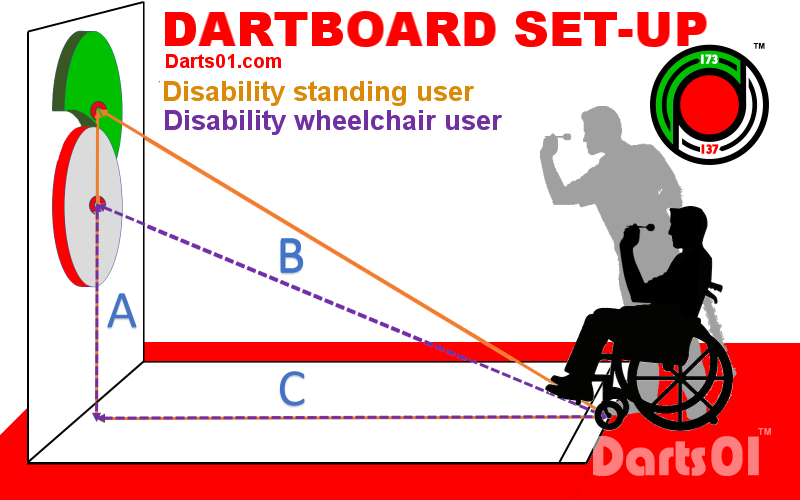
Dartboard Setup for Standing and Wheelchair Users
The dartboard should hang securely from a wall so that the centre bullseye is 5ft 8ins / 173cm from the floor, or 4’ 6” / 137cm for a wheelchair user. The toe-line or Oche 7ft 9 ¼ ins / 237cm shall be clearly marked and should be at least 18ins long. The toe line can be just a painted line on the ground or a securely raised line indicator, such as a piece of wood or metal. The latter is preferable as the thrower has a firm edge to rest their foot against.
The order of play is either determined by a coin toss or by each player throwing for the centre bull, with the nearest player throwing first. The rules here may vary depending on the league you are playing in; the local rules should be observed at all times.
Able-bodied or Disability Standing Player
Able-bodied or Disability standing player dartboard set-up is the same as standard dartboard set-up
| A: Height to Centre Bull | B: Centre Bull to Oche | C: Throw Distance |
| 5ft 8ins / 1.73m | 9ft 7 ½ins / 2.93m | 7ft 9 ¼ins / 2.37m |
Disability Wheelchair Player
| A: Height to Centre Bull | B: Centre Bull to Oche | C: Throw Distance |
| 4ft 6ins / 1.37m | 9ft 0ins / 2.74m | 7ft 9 ¼ins / 2.37m |
Note: Dartboard oche length can vary across leagues, so please refer to your local league rules. Soft-tip dartboard Oche length is 8ft (2.44m). See the dartboard setup page for further details on several different dartboards and their related setups.
If you wish to know more about disability/wheelchair darts, you can read the disability section on this website. There is also a World Disability Darts Association and a British Disability Darts Association, plus further Disability Darts Organisations around the World. More details....
Dartboards - How they are made?
Here is a short video showing how a dartboard is made. The first staple free dartboard I played on was a DMI / Puma Bandit. See here how they are made.
View this video on YouTube | Puma Darts Please wait to load before playing
Having played on most of these types of dartboards, including round wire and triangle, pyramid/diamond wire dartboards, I can personally say that blade-type construction dartboards are the best by far.
In addition to the standard 501 games we mainly see played in competition darts, there are a vast number of dart games that can be played. Some of the games can be found on this website. Please see the game section.
I have reviewed some of these dartboards for you, and you can read my review on the Darts501.com website.

Acknowledgements | Privacy, Cookies & Terms of Use | FAQ
